Pages

Saturday, June 19, 2010

City Centre of Kota Kinabalu, Sabah, Malaysia

Kota Kinabalu (KK), formerly known as Jesselton is the capital of Sabah, Malaysia. What I am going to tell you now  is some of the attractions in the city centre of Kota Kinabalu. Its centre lies along Jalan Tun Fuad Stephen on the coastal side and the few roads inland. The centre has blocks of commercial buildings and now more hotels and hotel apartments are under construction especially on the sea-reclamation area.

The apartments and the shopping area.


The park in between the buildings.

The Marina Court, apartments for hire on daily or monthly basis.

When you are in KK city centre, you cannot miss visiting a few places such as Pasar Budaya (they call it Filipino Market) which sells handicrafts and souvenir items. This market is a  single storey wooden market. It has many small stalls or cubicles which makes the patrons difficult to move around due to its narrow circulation area. If you want to buy, do bargain, at least 60 percent. If you want more quality, go to Jamilah Jewellery at the proper shop at Sinsuran Building at the back of La Meridien Hotel.

Next to this market is Pasar Ikan Masin (Dried Salted Fish Market). Here there are many dried sea food products such as dried prawn, dried salted fish, and other fish related products. It is considered cheap. But you still need to bargain as the opening price may be high.

The evening food stalls which sell grilled fish, grilled prawn, and other sea-food looks delicious. Its smell make your taste buds excrete saliva. If you want to taste the grilled fish and feel the atmosphere (like a sauna...), I think it is better to have it here. Ask for the price when you order the food and drink.

You also can buy fresh fish or prawn at the central market  which is about 100 metres from this market. You may get cheap if you go in the early morning. If you stay in the apartment (which allow cooking), certainty buying fresh fish from this market can save a lot. This is so if you are travelling with large family.

Brooch sold at Culture Market.

This is the real shop that sells many brooches and other crystals. You can be a member to get big discount.

One of the shopping complexes in the city centre. The one at 1 Borneo is even bigger but it is located 10km north. Behind this building is the bus station.

The daily market next to the Culture Market.

The evening food stalls near the market. Sabah is blessed with sea-food.

Patrons are having dinner at the stall.

Nowadays, the space between the buildings are covered with special roof and are equipped with air-conditioner. This made the patrons comfortable.

The traffic at the market.

The front of the Salted Fish Market.

Other places of interest for shopping are Centre Points where many upmarket products are sold. 1 Borneo is a new shopping mall for KK but it is located away from the city centre. There is a free shuttle bus  from the city to 1 Borneo. If you are interested, go to the bus stop opposite the culture Market or ask around.

Beside the shopping, do visit the water front, the museum, Signal Hill (where you can see the entire city facing the sea), Likas Bay and Tanjong Aru (where the beach is). This is what I call city tour.

If you want independent travelling without guide, you can take mini-buses at the station near the Plaza Wawasan. Happy Travelling.


Sunset in Kota Kinabalu, Malaysia

Kota Kinabalu is the state capital of Sabah. It is located on the north-west of the island of Borneo which is now having Sabah, Sarawak, Brunei and Kalimantan (Indonesia). The picture below shows a very serene atmosphere with blue water, boats and trees. Those who like fantasy, calmness, you can watch this panorama.

This looks beautiful with the blue water.

The next picture is the sunset in Kota Kinabalu. I took this picture from the same spot. You can see the sun set in layers of clouds with red lining.


The sun set, a view from Marina Court.

If you want to take the picture of this sunset, observe at 6.30pm. If there is no rain or others, certainly you will see this panorama. Happy observing.

Sunday, June 13, 2010

A Visit to South Africa


South Africa is a big country on the southern tip of the African continent. It was once under the Dutch and British colonialists. Major cities are Pretoria (the capital), Johannesburg, Durban and Cape Town. Of all four cities, perhaps Durban and Cape Town are the nicest as they have beautiful beaches. Johannesburg is the largest of all. South Africa faces two oceans i.e. Atlantic and Indian Oceans. I am going to tell you about South African cities that I have visited.


A street in Pretoria. Look at the blooming jakaranda flowers...You have to go in October to see this flowers. Pretoria is an hour by road from Johannesburg. On the way to this capital, you can see a lot of shanty houses.


Pretoria, a view from the administrative buildings. It is modern and clean. Note that the big park below is one of the best parks in Pretoria.

Johannesburg, the biggest city. A commercial centre for South Africa. A view from the hotel.


One of the flea markets in Johannesburg. It sells many things ranging from clothes, food, souvenirs, cooking utensils, bedding etc. Some of the products are laid on the ground. I found this market is lively with sorts of music especially african dance.

Cape Town, a city that attracts many tourists. On the left is the Table Mountain. This road is leading towards the city centre. The bridge is actually a dedicated pedestrian bridge, linking the residential areas and the commercial areas on the right.

The penguin community at Simon's Town on the eastern part of Cape town. It is a half-day journey to this town. These penguins are not afraid of people.

If you are interested to visit South Africa, it is advisable to go in October as it is near summer. The temperature is okay. You can stop at Johanesburg first and then visit the cities or places around it  such as Pretoria, Wildlife Park, Sun City ( a city that was developed on volcanic crater or caldera), then fly to Cape Town. It takes 2 hours by air to cape Town. In Cape Town, visit Victoria and Alfred Waterfront, the Hout Bay, Chapman's Peak and Simon's Town. You will pass a very historical geological formation  along this route. The cliff at this Peak had stratified or layers which I suppose geologists must be very interested to study. Do visit Cape Point where you can see where two oceans meet. Happy travelling.


Tuesday, June 8, 2010

House boats in Kenyir Lake, Terengganu, Malaysia

Kenyir Lake is one of the largest man-made lakes in South-east Asia. It is located in Terengganu, Malaysia. The lake is the result of damming the upper stream of Terengganu river to harness hydro-electric power in 1985. As the water level rises, it also creates 230 islands in the lake. These islands were once peaks of hills.

What I am going to tell you is the house boat in this lake. House boat in Kenyir Lake is one of its kind in Malaysia. It is  designed by their owners. It consists of a simple boat with an extension to its roof and facilities. Some are double storeys. If you visit Kashmir in India, you will also see house boats. But they are of different design. The ones in Kashmir are quite hospitable as leisure house boats.

In Kenyir, house boats are used as a camping point, a fishing platform or a simple accommodation. They have sleeping berths, place for eating or lounge, a simple kitchen for simple cooking and the floating toilet. Some owners installed air-conditioners or fans in their boats. These boats are anchored at certain locations. The boats also can move about the lake and therefore they are not static.

House boats are anchored by the lake side.

The moving house boat. They were on islands hopping in the morning.

There are many types of house boats.

This one is very simple house boat.

Some house boats are equipped with air-conditioner or fans.

Another simple house boat.

Pengkalan Gawi.

Another view of Pengkalan Gawi.

If you are interested to experience this house boats in Kenyir Lake, you can go to Pengkalan Gawi which is about 80 km from Kuala Terengganu. When you reached Pengkalan Gawi, go to the travel agent kiosks nearby and ask or book the house boats. The rent of the house boat per day or 24 hours is around RM1000.00-RM1200.00. Hiring this boat entitles you to move around the islands or island hopping. It is advisable to go in group as you can reduce the cost per person.The boat can accommodate around 15-20 people at a time. Bring simple cotton clothes as the humidity is high here. Night is warm. Morning is cooler. Happy travelling.

Saturday, June 5, 2010

Buildings in Hanoi and Saigon

Many cities in Vietnam are old cities. Some buildings in these cities reflects their colonial past e.g. the French or Americans. I had visited two principal cities of Vietnam: Hanoi (the capital) and Ho Chi Minh City. 

For Hanoi, old buildings (narrow)  are mostly located in the old quarter area. Once you move out of the old area, you see more normal buildings. Hanoi's old quarter brings old memories to many people as their activities like making tin container, making bamboo furniture or mending metal parts are still in the city centre. They have not been relocated in a special industrial area.

Very narrow building is common in Hanoi.

Buildings in the Hanoi's Old Quarter.

Bamboo furniture making is still alive in Hanoi's Old Quarter.

Hanoi's Opera House is quite different from other buildings. 

Hanoi's commercial area that invites many foreign tourists.

A barber shop in Hanoi. The glass reflection of the door gives way for the scooters...

Hanoi's old quarter building looks elegant in its way.

In Saigon, the buildings are modern and its environment are shaped by many factors such as land values and demand for tall buildings. I found buildings in old Hanoi is influenced by the small  lot size and its narrow road. They can not expand. While in Saigon, roads are broader. This road width issue plays a big role in influencing the building design and construction in Vietnam.

Narrow building in Saigon.

Saigon's Opera house, a remnant of French colonial past.
Old buildings and new tall buildings at the back. This is in Saigon.

Modern building in Saigon.

Buildings like these are mushrooming in Saigon.

For Hanoi, lots of buildings can be declared as historical buildings. For that matter, Old Quarter of Hanoi can be preserved and  promoted  as Heritage Area. Outside this area, developments are moving towards the west where there are large plots of land where better design can be applied.

For Saigon, I observed it is like any other cities of the world: congested. The plus point is that its roads are wider. The city layout is on the grid-iron pattern. You will not lost in your city explore exercise. Happy travelling.

Friday, June 4, 2010

How hard to cross a road in Ho Chi Minh city

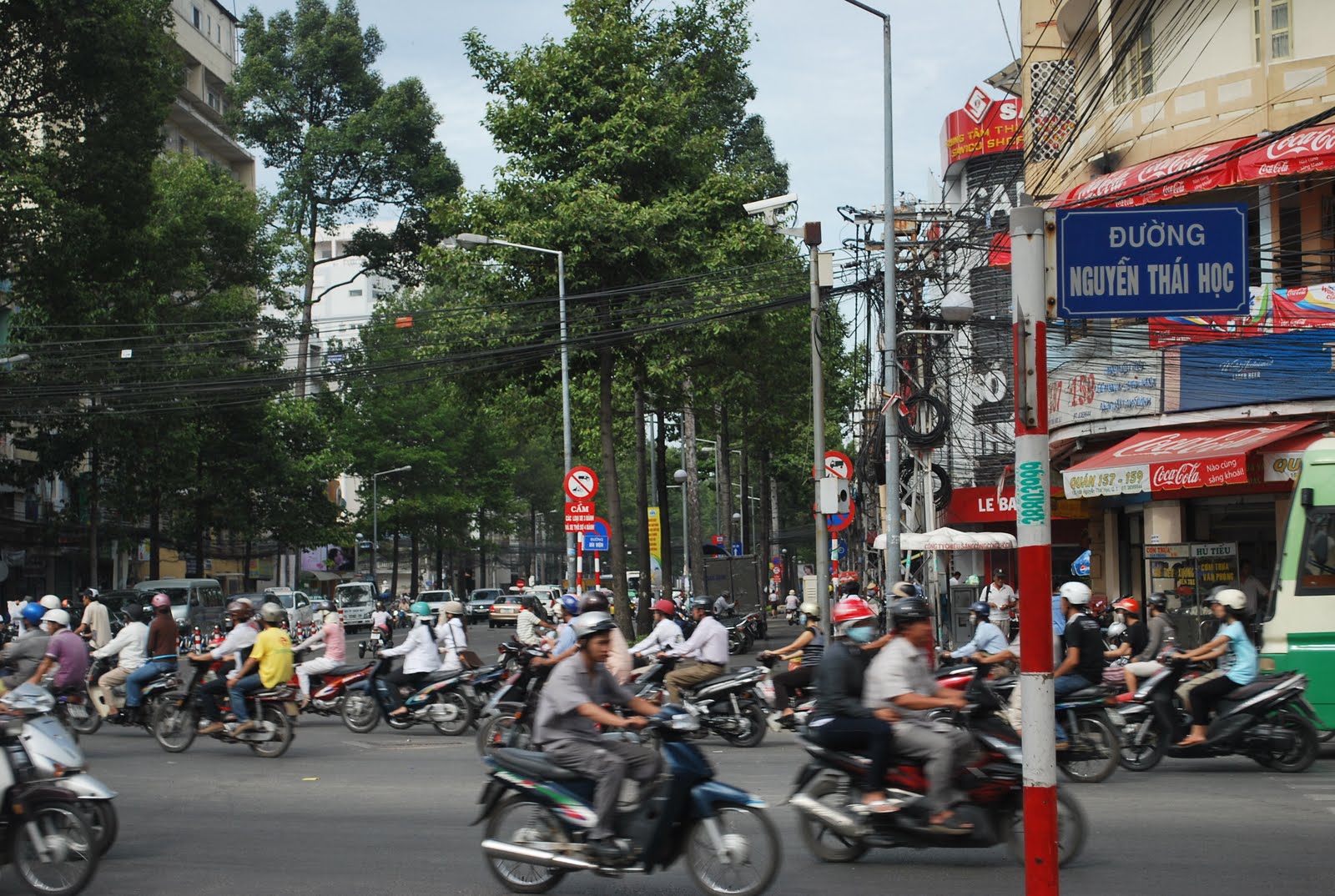
Saigon or Ho Chi Minh City is a city full of motorcycles. Being the main mode of transport, motorcycles seem to be the king of the road. City people uses motorcycle everyday to go to work. 

As seen, there are many motorcyclists on the road in Ho Chi Minh City.

I found it is difficult to cross the road. Saigon's left hand drive means when you cross a road you have to look at the left and then rightt. If there is no traffic, you cross. 

In Ho Chi Minh City (HCMC), few places have traffic light crossings. Some have zebra crossing but there is no light to stop the motorists. In this situation, you are on your own. If you got the courage, you cross. If not, you wait until there is less traffic.  I did not come across any overhead pedestrian bridge in this city centre.


Wow, motorcycles every where.....


Even at night, the motor cyclists are still on the road.


Quite a confusing state..which direction?


Endless flow of traffic at the city centre made crossing difficult. This is right in front of the Ben Thanh market.

When there is endless flow of traffic and they do not give you chance to cross, you can still cross the road at your own risk. My experience is that I used my map to wave to the motorists indicating I am crossing the road. When they saw me flagging my map, they slow down.  Then I quickly walked past to the other side of the road. 

I escaped being knocked by motorists at least three times simply because I look at the right first. I did not realized that motorists come from my left. The wider the road, the bigger the challenge to cross the road.

Next time when you are in Ho Chi Minh City, beware of the traffic. Do not endanger yourself when you cross the road. Happy travelling.

Saturday, May 29, 2010

A Visit to Cu Chi Tunnel, Vietnam

I had the opportunity to visit Ho Chi Minh City. One of the itineraries is to visit Cu Chi tunnel. These tunnels were dug up by the Vietnamese years ago especially in their fighting against their enemies. Vietnam's war history dated back in 1860 until 1980. It took 120 years of war killing millions of people and leaving many people loss their parts of their bodies. The last war was with China (northern region). I learned more on Vietcong Vs Americans in the 1970's. The war made many Vietnamese fled the country and became refugees. Some landed in Australia, USA and Canada. Now , the war was over. The tunnels are open for the public to see. This tunnel was declared as historic vestige site on December 15, 2004  by the government. It becomes a source of income through gate ticketing.

Cu Chi is about 70km north-west of Ho Chi Minh city. It is a rural area. Going to visit the tunnels, you must pass through villages, country side, rubber plantation and agricultural areas. Once you reach the Cu Chi tunnel, you pay VD75,000 for the entrance. You walk down the concrete tunnel first, then you are ushered to a sunken hut which display the video on the war and tunnel. Then you are introduced to the tunnel.

Inside the hut where briefing on the tunnels was done.


The briefing by this war veteran is also given on the bus before you arrive at the tunnel..

The guide (a war veteran) gave the briefing on the tunnels. The tunnels have three layers: the top, middle and lower level. I was told the tunnels have meeting rooms, accommodation, kitchen, toilet etc. The water is taken from Saigon river nearby. Actually there are two sites, but we were only introduced the tunnels at Ben Dinh.

The opening of the tunnel. Only a small body can go in this tunnel. The fat person if insist will be stuck.

I tried to experience the tunnel. I am  fat and found difficulty to come out.....

Visitors attentively listening to the guide's briefing.

Entering the tunnel. It is very narrow and low. It can accommodate small frame people.

If you can not proceed crawling inside the tunnel, it is better to come out. There are many exit points along the way. The tunnel is winding and you can hide.

The attap roof (dried leaves) of the tunnel.

Some bombs were displayed.

If you are interested to visit, you can contact the local travel agent. The fee to and fro is USD5 excluding the lunch and entrance fee. Dress comfortably in case to need to crawl in the tunnel. To know details go to this web www.chuchitunnel.org.vn  Happy travelling.